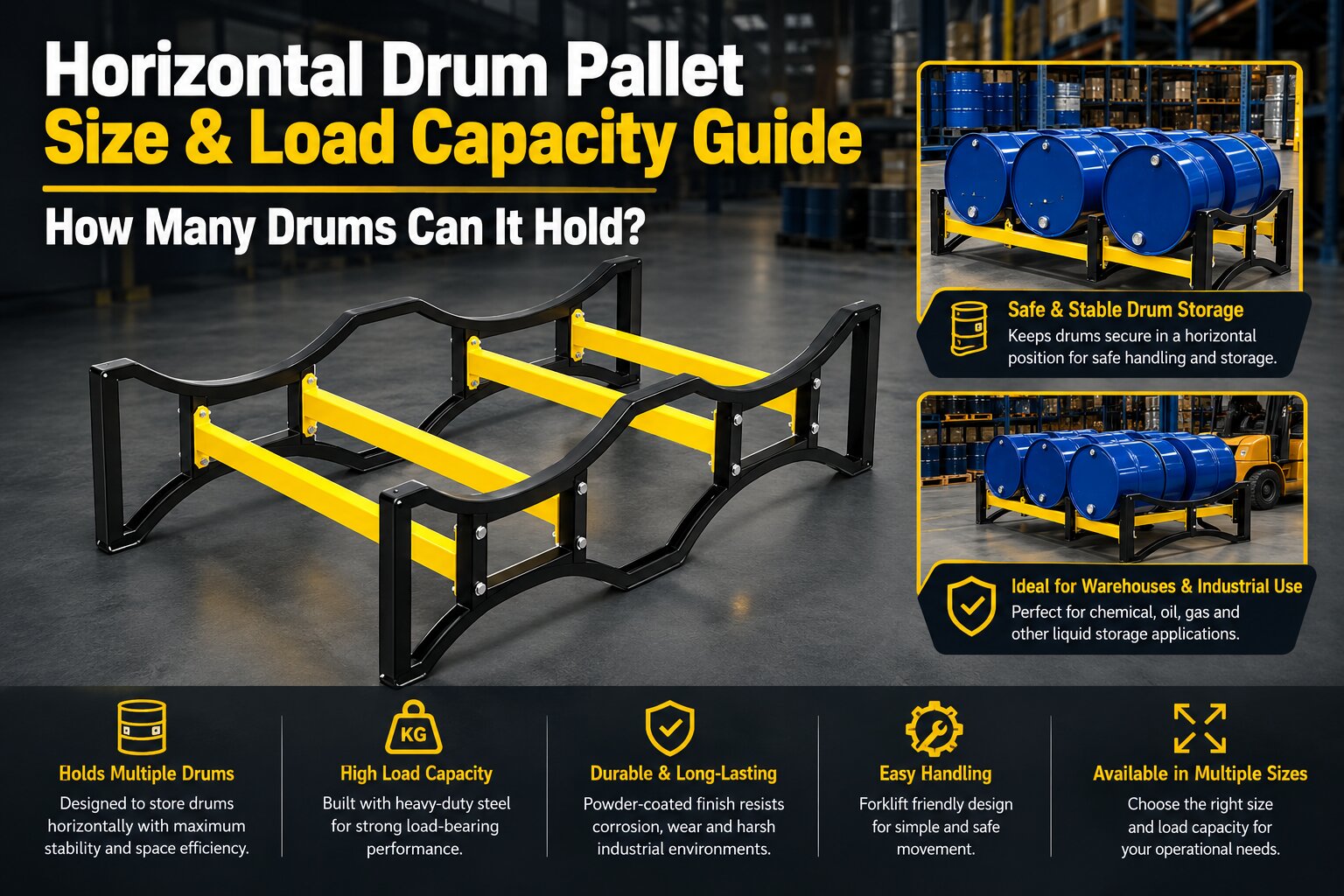
Industrial drums are widely used to store and transport oils, lubricants, chemicals, paints, and other materials. Keeping these drums properly organized is important for safe handling, efficient storage, and better use of warehouse space.
A horizontal drum pallet is designed specifically to support drums in a horizontal position while allowing them to be handled using suitable material-handling equipment. Horizontal drum pallet manufacturers provide different pallet sizes, configurations, and load capacities to meet various industrial storage and handling requirements. But how many drums can one pallet hold? What is the standard size? And how much weight can it safely handle? This guide explains the key specifications, load capacities, and selection factors you should consider before choosing a horizontal drum pallet.
A horizontal drum pallet is a steel storage and handling pallet designed to hold industrial drums horizontally. Its structure provides dedicated support for the drums and allows the loaded pallet to be moved using forklifts, pallet trucks, or stackers, depending on the pallet design.
These pallets are commonly used in:
1) Chemical industries
2) Oil and lubricant storage
3) Manufacturing facilities
4) Pharmaceutical industries
5) Warehouses and logistics
6) Paint and industrial material storage
Compared with storing drums directly on the floor, a dedicated drum pallet helps create a more organized and manageable storage system.
The size of a drum pallet should be selected according to the dimensions of the drums being stored and the handling equipment used in the facility . The standard Stakall horizontal drum pallet specification is:
|
Specification |
Details |
|
Width |
1280 mm |
|
Depth |
720 mm |
|
Height |
370 mm |
|
Drum Capacity |
2 drums |
|
Material |
Mild Steel |
|
Finish |
Powder Coating |
|
Handling |
Forklift / pallet-handling equipment |
|
Customization |
Available based on requirements |
The dimensions may vary for customized applications. If you use drums with non-standard dimensions, it is important to confirm the required pallet size before ordering.
A standard Stakall horizontal drum pallet is designed to hold 2 drums in a horizontal position. As experienced steel pallets manufacturers, Stakall designs pallets with a focus on proper load distribution, stability, and safe industrial handling. The number of drums should not be increased beyond the pallet's specified design capacity.
Adding extra drums may affect load distribution, stability, and safe handling. For warehouses that need to store a larger number of drums, multiple pallets can be arranged according to the available floor space and material-handling system.
Load capacity is one of the most important factors to check before selecting a pallet. For the standard Stakall horizontal drum pallet, the listed capacities are:
|
Load Type |
Capacity |
|
Dynamic Load Capacity |
450 kg |
|
Static Load Capacity |
1880 kg |
Static load refers to the weight a pallet can support while it remains stationary under the specified conditions.
Dynamic load refers to the load capacity when the pallet is being handled or moved using suitable material-handling equipment.
For example, a pallet may support a significantly higher load while stationary than it can safely handle while being moved. The actual safe working load should always be confirmed based on the pallet design, drum weight, handling equipment, operating conditions, and application.
Horizontal drum pallets are generally designed around standard industrial drum dimensions. However, drum sizes can vary depending on the manufacturer and application.
Before selecting a pallet, check:
1) Drum diameter
2) Drum height or length
3) Empty drum weight
4) Filled drum weight
5) Number of drums
6) Drum material
7) Handling method
8) Storage conditions
For customized applications, pallet dimensions can be adjusted according to the required drum size and storage system.
A properly designed drum pallet can offer several advantages in industrial storage and handling.
1. Organized Storage
Drums remain in a defined storage position instead of being placed randomly across the warehouse floor.
2. Easier Handling
Forklift-compatible pallet designs can simplify the movement of multiple drums between storage and operational areas.
3. Better Space Utilization
A planned pallet arrangement can help warehouses make more efficient use of their available storage space.
4. Improved Drum Stability
The pallet provides a dedicated support structure to help keep drums positioned properly during storage and handling.
5. Reusable Solution
Steel pallets are designed for repeated industrial use and can provide a durable alternative to disposable storage solutions when used correctly.
The choice between horizontal and vertical drum storage depends on the application, available space, drum dimensions, and handling requirements.
|
Feature |
Horizontal Drum Pallet |
Vertical Drum Pallet |
|
Drum Position |
Horizontal |
Vertical |
|
Storage Arrangement |
Horizontal storage |
Vertical storage |
|
Capacity |
Typically 2 drums in the standard design |
Depends on pallet configuration |
|
Handling |
Forklift / pallet equipment |
Forklift / pallet equipment |
|
Best Considered For |
Horizontal drum storage and handling |
Applications requiring vertical drum storage |
|
Selection Factors |
Drum size, weight, space and handling |
Drum size, storage height and handling |
The right option depends on how the drums are stored, accessed, moved, and used within the facility.
Before purchasing a horizontal drum pallet, consider the following factors:
1. Measure the Drum
Check the diameter and height or length of the drum. The pallet should provide adequate support without compromising stability.
2. Calculate the Total Weight
Calculate the combined weight of the filled drums and compare it with the applicable pallet load capacity.
3. Check Your Handling Equipment
Confirm that the pallet is compatible with your forklift, pallet truck, stacker, or other handling equipment.
4. Consider Available Warehouse Space
Check the pallet's width, depth, and height along with aisle width and available storage space.
5. Check Stacking Requirements
If pallets need to be stacked, confirm the permitted stacking arrangement and load conditions with the manufacturer. Stacking should always follow the product's specified operating requirements.
6. Consider the Working Environment
The pallet finish and material should be suitable for the environment in which it will be used. Powder-coated mild steel is one commonly used configuration for industrial applications.
7. Ask About Customization
If you use non-standard drums or have specific storage requirements, ask the manufacturer about customized dimensions and configurations.
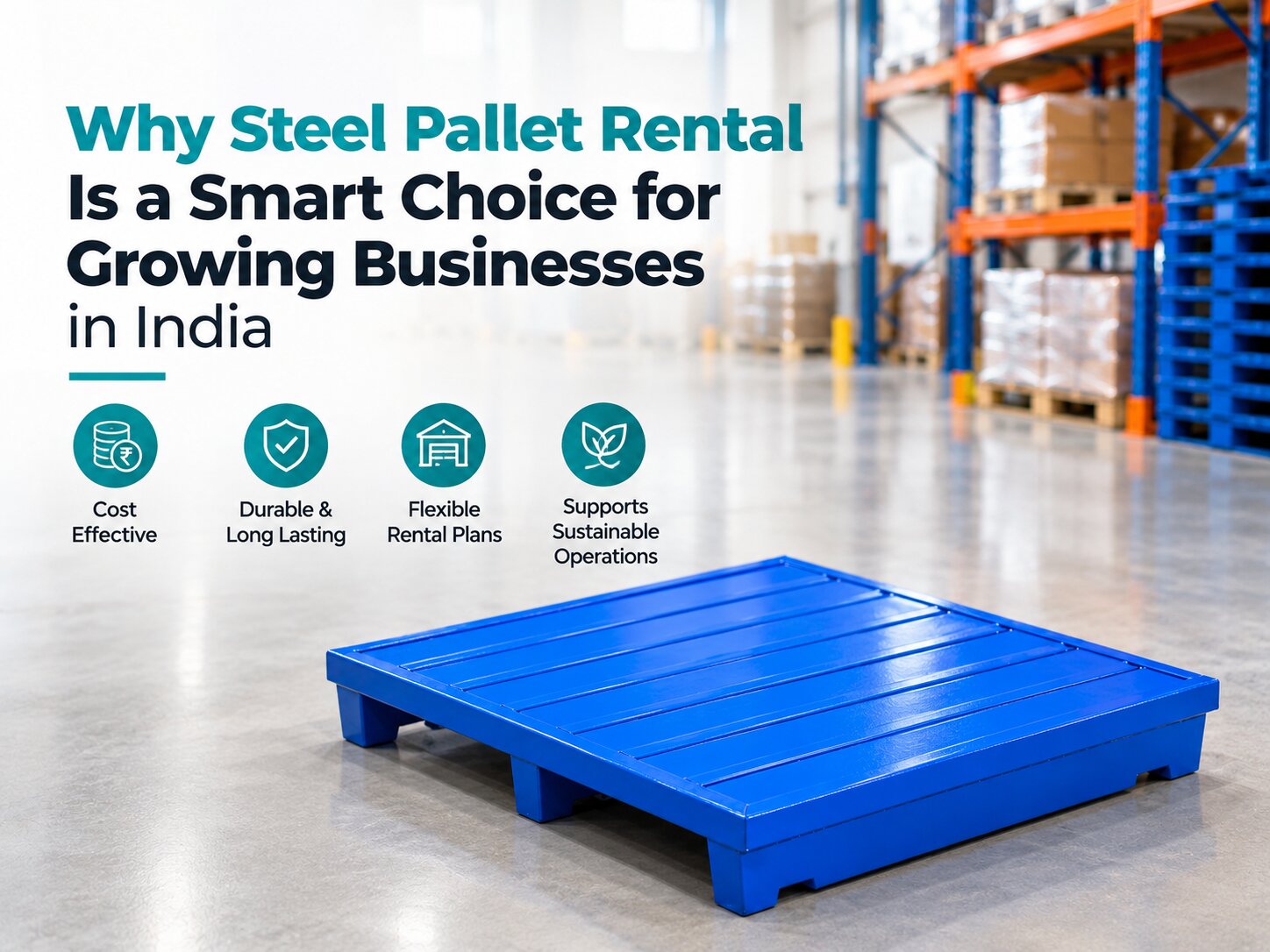
Steel is commonly used for industrial pallets because of its strength, durability, and ability to withstand repeated handling. Steel pallets can be suitable for warehouses and manufacturing facilities where products are regularly handled by forklifts and other material-handling equipment. Depending on the application, steel pallet solutions are available in different configurations, including drum pallets, standard steel pallets, cage bins, and other industrial storage products.
Stakall manufactures industrial storage and material-handling solutions, including horizontal drum pallets and steel pallets. Its standard horizontal drum pallet is designed to accommodate 2 drums horizontally, with a listed size of 1280 × 720 × 370 mm, a 450 kg dynamic load capacity, and an 1880 kg static load capacity. For applications involving different drum sizes, load requirements, or handling systems, customized solutions can also be considered based on the specific requirements.
A horizontal drum pallet can be a practical solution for businesses that need organized and efficient drum storage and handling. Before selecting a pallet, it is important to consider the drum dimensions, total weight, load capacity, handling equipment, warehouse space, and stacking requirements. Choosing the right industrial pallet systems can also help improve storage efficiency and support safer material handling. The standard Stakall horizontal drum pallet is designed to hold 2 drums and has a listed size of 1280 × 720 × 370 mm, with 450 kg dynamic and 1880 kg static load capacities. Choosing the right configuration based on your actual application can help create a safer and more efficient drum storage system.
1. How many drums can a horizontal drum pallet hold?
A standard Stakall horizontal drum pallet is designed to hold 2 drums in a horizontal position.
2. What is the standard size of a horizontal drum pallet?
The standard Stakall horizontal drum pallet measures 1280 mm × 720 mm × 370 mm (W × D × H).
3. What is the load capacity of a horizontal drum pallet?
The listed load capacity is 450 kg dynamic and 1880 kg static. The appropriate capacity should be confirmed for the specific application and operating conditions.
4. What material is used to manufacture horizontal drum pallets?
The standard Stakall horizontal drum pallet is made from mild steel and has a powder-coated finish.
5. Can horizontal drum pallets be customized?
Yes. Customized dimensions and configurations can be considered based on drum dimensions, load requirements, storage conditions, and handling requirements.
6. Are horizontal drum pallets suitable for forklifts?
Horizontal drum pallets designed for industrial material handling can be handled using suitable forklifts, pallet trucks, or stackers, depending on the specific pallet design and equipment.
7. How should I choose the right drum pallet?
Consider the drum size, filled weight, number of drums, required load capacity, handling equipment, available warehouse space, and stacking requirements before selecting a pallet.