Modern warehouses are under constant pressure to store more inventory, improve operational efficiency, reduce handling time, and make better use of available floor space. As businesses grow, choosing the right storage system becomes an important investment decision.
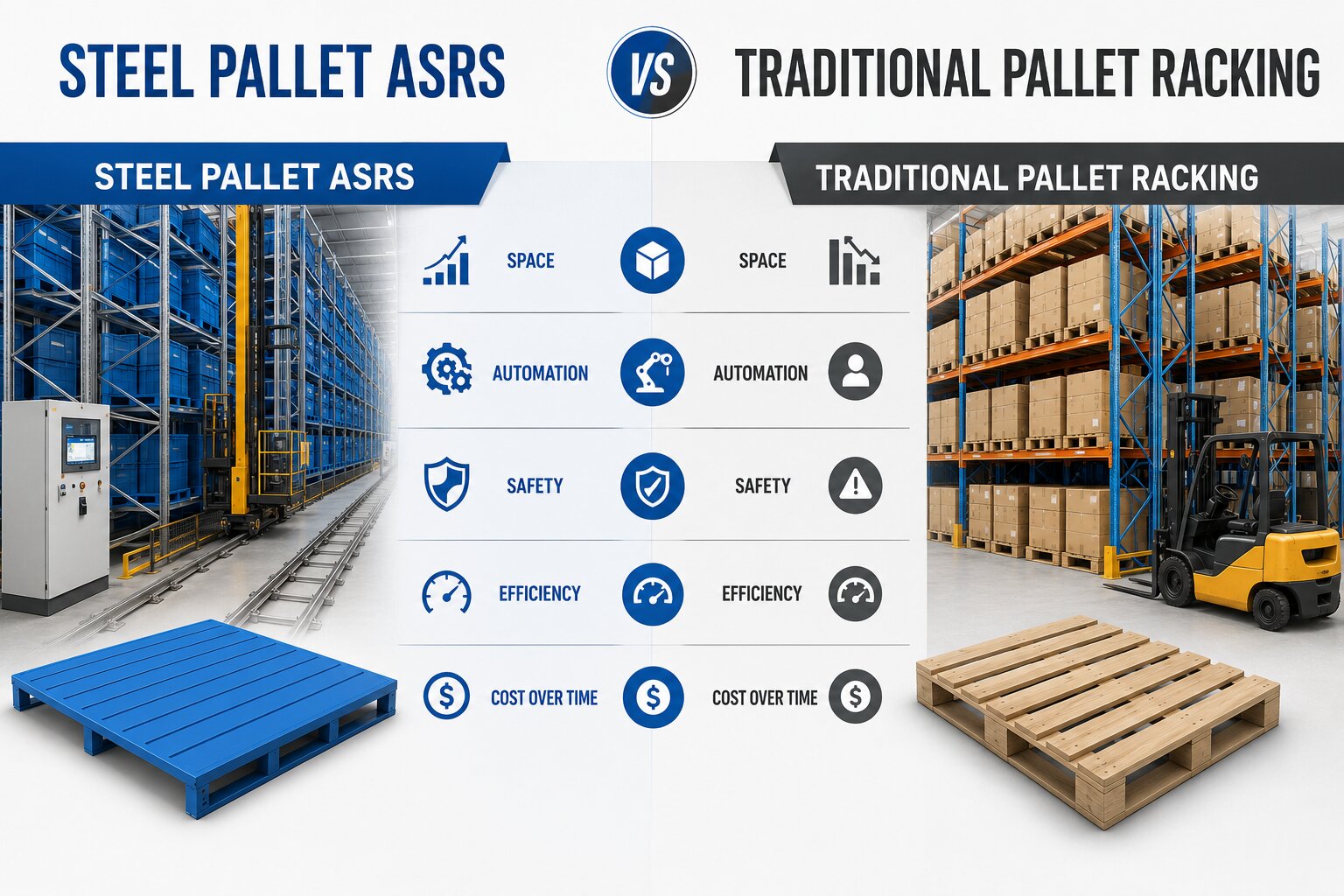
Two commonly considered options are Steel Pallet ASRS vs Traditional Pallet Racking. Traditional pallet racking relies mainly on forklifts and manual warehouse operations, while an Automated Storage and Retrieval System (ASRS) uses automated equipment and software to store and retrieve palletized goods.
For warehouses handling heavy loads, frequent inventory movement, and high-density storage requirements, steel pallet ASRS solutions can provide significant advantages. However, traditional pallet racking can still be practical for smaller operations with lower automation requirements.
This guide compares both systems to help warehouse managers understand their differences and choose the right solution for their operations.
A Steel Pallet ASRS is an automated storage and retrieval solution that uses equipment such as stacker cranes, conveyors, shuttles, and warehouse management software to automatically store and retrieve palletized goods. The system uses specially engineered ASRS-compatible pallets, including steel pallets designed to maintain dimensional stability, provide reliable load support, and ensure smooth automated handling. This is particularly important because ASRS equipment requires consistent pallet dimensions and structural strength for accurate movement and positioning. Stakall manufactures steel pallets and ASRS-compatible metal pallets designed for automated warehouse applications.
Unlike conventional storage, where operators use forklifts to locate and move pallets, ASRS reduces manual intervention and can provide better inventory control, improved space utilization, and greater operational consistency.
Traditional pallet racking is a conventional warehouse storage system where pallets are stored on fixed racks and accessed using forklifts or other material-handling equipment. Selective pallet racking is one of the most common examples. It provides relatively direct access to individual pallet locations and can be suitable for warehouses with moderate storage volumes and flexible inventory requirements.
Traditional racking is generally easier to implement than a fully automated system, but it requires warehouse aisles for forklift movement and depends more heavily on operators for storage and retrieval activities.
|
Feature |
Steel Pallet ASRS |
Traditional Pallet Racking |
|
Storage Method |
Automated |
Mainly manual |
|
Material Handling |
Stacker cranes, conveyors, shuttles, or automated equipment |
Forklifts and pallet trucks |
|
Space Utilization |
High, particularly vertically |
Moderate |
|
Labor Requirement |
Lower |
Higher |
|
Inventory Tracking |
Highly integrated with software |
Often dependent on WMS and manual processes |
|
Retrieval |
Automated |
Operator-driven |
|
Storage Density |
High-density storage possible |
Depends on rack configuration and aisle requirements |
|
Initial Investment |
Higher |
Generally lower |
|
Scalability |
Strong for high-volume operations |
Flexible for conventional operations |
|
Best For |
High-volume, high-density warehouses |
Small to medium or manually operated warehouses |
1. Space Utilization
Space is one of the biggest factors when evaluating Steel Pallet ASRS vs Traditional Pallet Racking. Traditional pallet racking requires aisles wide enough for forklifts and operators to safely access pallet positions. This can reduce the amount of floor area available for actual storage. Steel Pallet ASRS can use vertical warehouse space more efficiently because automated equipment can operate within high-density storage structures. This makes ASRS particularly useful when land or warehouse floor space is expensive or limited. For businesses planning to increase storage capacity without significantly expanding their building footprint, automated storage can be an attractive option.
2. Labor Requirements
Traditional pallet racking depends heavily on forklift operators and warehouse personnel for pallet movement, put-away, picking, and retrieval. ASRS automates many of these repetitive activities. Warehouse software can determine where inventory should be stored while automated equipment handles the movement. This does not mean that ASRS completely eliminates warehouse employees. Instead, it can reduce the amount of manual material handling and allow employees to focus on inventory management, maintenance, quality control, and other higher-value activities.
3. Inventory Accuracy
Inventory accuracy is another major difference between the two systems. With traditional racking, inventory movements may involve several manual steps, creating opportunities for misplaced pallets or data-entry errors. An ASRS can integrate storage and retrieval activities with warehouse management software. Every movement can be digitally recorded, helping warehouse teams maintain better visibility of inventory locations. For companies handling large SKU volumes or frequent inventory movements, this level of automation can make warehouse control more consistent.
4. Safety and Load Stability
Warehouse safety is especially important when handling heavy industrial products. A steel pallet provides a strong and durable platform for demanding applications. Compared with materials that can be more susceptible to moisture, pests, or breakage, steel pallets are designed for long-term industrial use and can provide reliable load support. Stakall's steel pallet solutions are designed with structural strength, rack compatibility, and automated handling requirements in mind. For ASRS applications, pallet dimensional consistency is particularly important because automated cranes and handling equipment depend on accurate positioning.
5. Durability of Steel Pallets
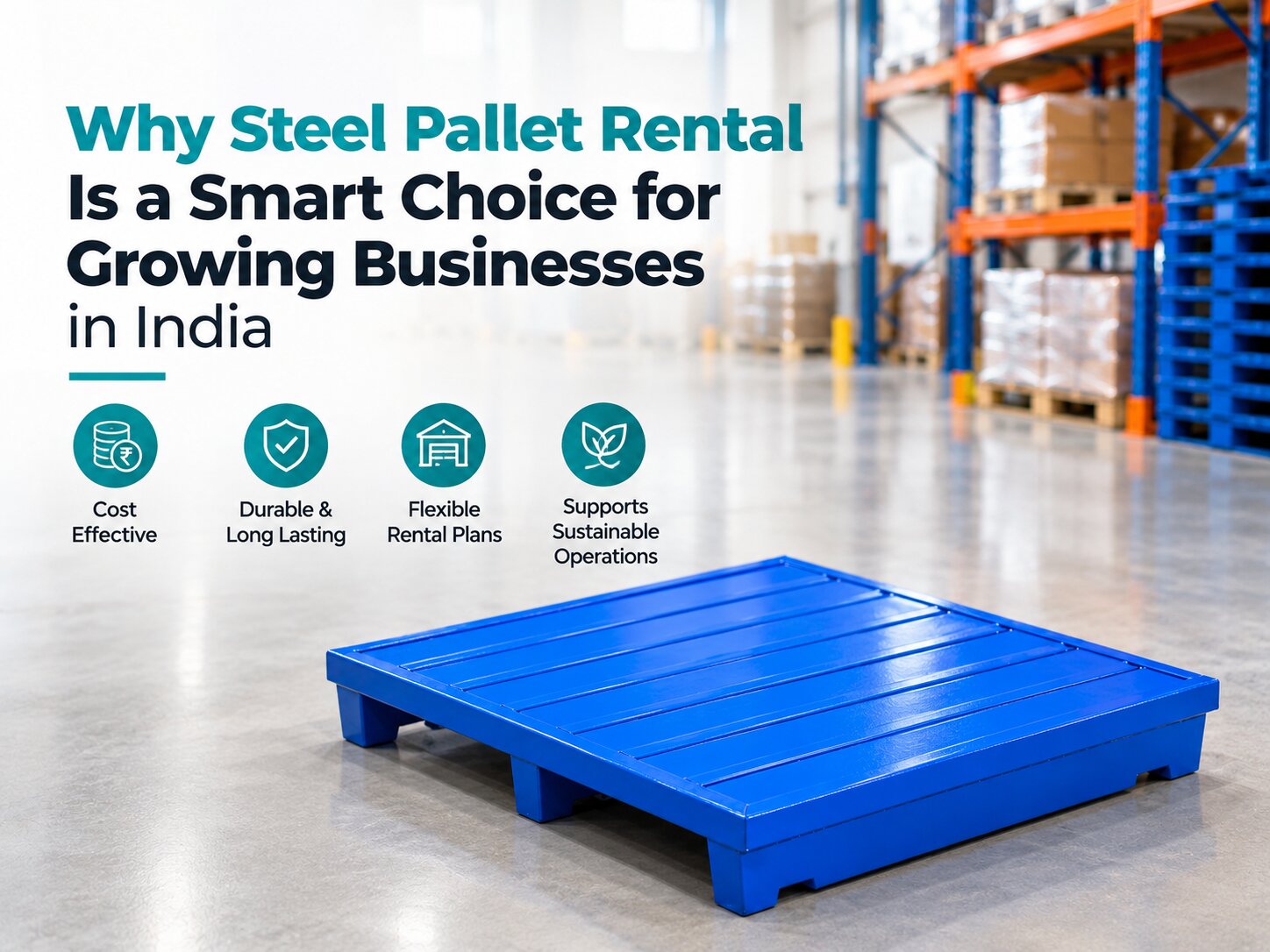
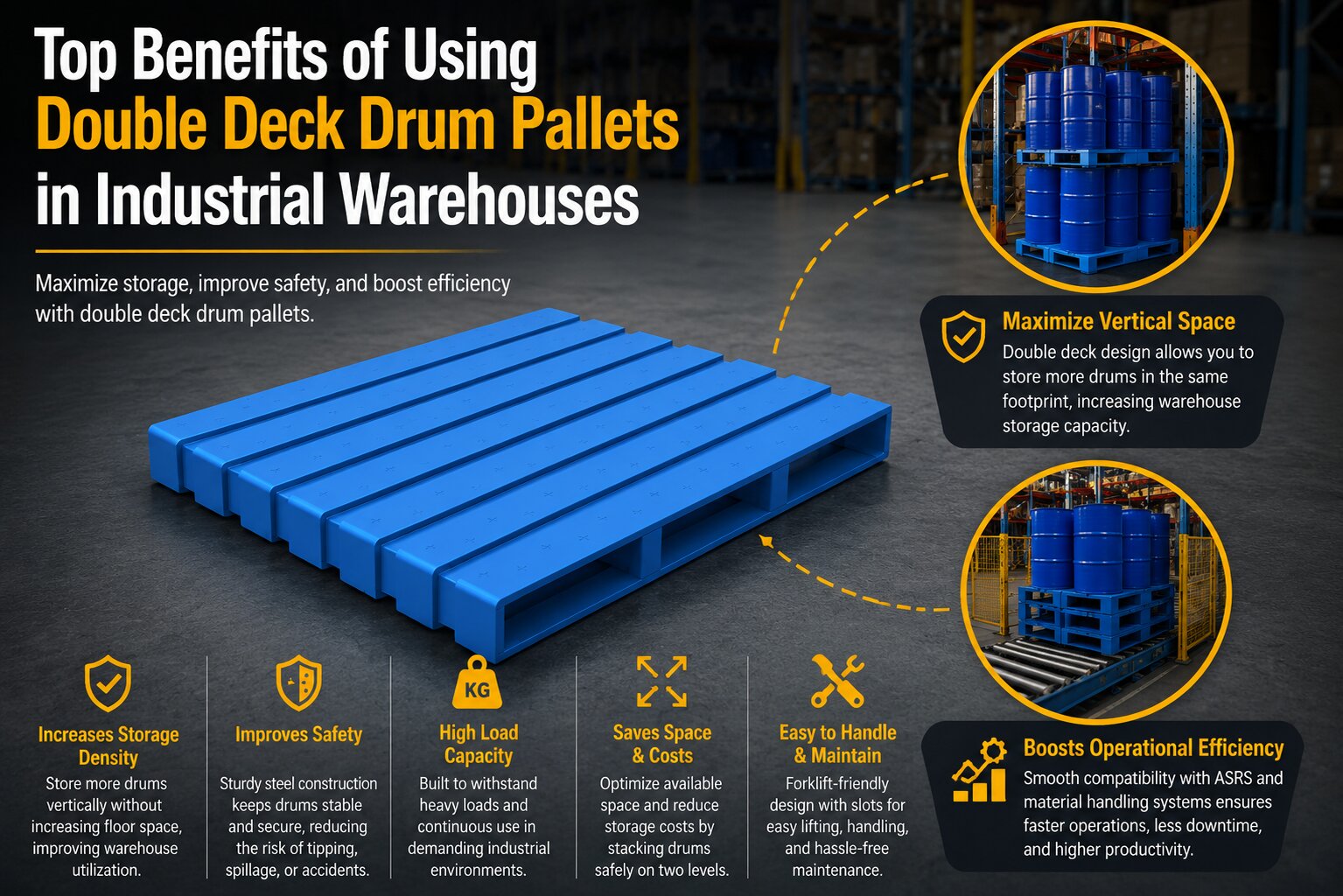
The pallet itself plays an important role in an automated warehouse. Wooden pallets can experience wear, moisture-related issues, splintering, or dimensional changes over time. Plastic pallets can be suitable for many applications, but their performance depends on the load, environment, and design. A properly engineered steel pallet is designed for repeated industrial handling and heavy loads. Stakall offers multiple steel pallet configurations, including heavy-duty corrugated top, light-duty corrugated top, plain top, tubular top, and double-deck drum pallet designs. For automated systems, metal pallets for ASRS systems can be engineered with dimensions and load capacities suited to the specific storage and handling equipment.
6. Initial Investment
One of the main disadvantages of ASRS is the higher initial investment.
An automated system may require:
1) Automated storage equipment
2) Stacker cranes or shuttles
3) Conveyors
4) Warehouse control software
5) System integration
6) ASRS-compatible pallets
7) Installation and commissioning
Traditional pallet racking generally requires a simpler infrastructure consisting primarily of racks, forklifts, and associated warehouse equipment.
Therefore, a small warehouse with relatively low throughput may find traditional racking more economical.
However, businesses should evaluate total cost of ownership, rather than comparing only the initial purchase price. Reduced manual handling, better space utilization, improved inventory control, and lower operational dependency can contribute to the long-term value of ASRS.
7. Maintenance and Operational Requirements
Traditional racking is comparatively straightforward to operate, but forklifts, racks, and other equipment require regular inspection and maintenance. ASRS has more sophisticated equipment and therefore requires specialized maintenance and technical support. Preventive maintenance is important for keeping automated equipment operating reliably.
The right choice depends on the warehouse's technical capabilities, operating schedule, expected throughput, and availability of service support.
When the warehouse requires heavy-duty performance, repeated handling, and compatibility with automated storage systems, a steel pallet can be a strong choice.
|
Factor |
Steel Pallet |
Traditional Wooden Pallet |
|
Durability |
High |
Moderate |
|
Heavy-load Handling |
Excellent for suitable designs |
Depends on construction |
|
Moisture Resistance |
High |
Lower |
|
Pest Resistance |
High |
Can be vulnerable |
|
Fire Resistance |
Non-combustible |
Combustible |
|
Reusability |
High |
Moderate |
|
ASRS Suitability |
Excellent when designed for the system |
Depends on pallet condition and ASRS requirements |
|
Maintenance |
Generally low |
Can require replacement/repair |
The correct pallet should always be selected according to the required load capacity, dimensions, handling equipment, rack configuration, and operating environment.
Choosing the right Steel Pallet ASRS manufacturer is important because pallet design directly affects warehouse performance.
Stakall has been engineering storage and material-handling solutions since 1991 and offers steel pallets and ASRS-compatible metal pallet solutions for industrial applications. Its manufacturing capabilities include precision fabrication and robotic/MIG welding, with pallet designs available for different load requirements and operating environments.
Stakall's steel pallet solutions can be customized based on:
The company offers options such as heavy-duty corrugated top, light-duty corrugated top, plain top, tubular top, and double-deck drum pallets.
When Should You Choose Steel Pallet ASRS?
Steel Pallet ASRS may be a better choice when your warehouse has:
Industries such as automotive, pharmaceuticals, logistics, chemicals, e-commerce, food processing, and heavy engineering can benefit from appropriately designed automated storage and steel pallet solutions.
Traditional pallet racking may be more suitable when:
1) The warehouse has a smaller storage volume
2) Inventory movement is relatively low
3) Manual operations are already efficient
4) The business has a limited automation budget
5) Flexible manual access is more important than maximum density
6) The warehouse does not require high-speed automated retrieval
For these businesses, investing in a sophisticated ASRS may not provide enough operational benefit to justify the initial investment.
Before making a decision, warehouse managers should evaluate:
1) Storage volume: How many pallets need to be stored?
2) Throughput: How frequently are pallets moved?
3) Available space: Is warehouse expansion difficult or expensive?
4) Labor costs: How much manual handling is required?
5) Load requirements: What are the average and maximum pallet loads?
6) Inventory complexity: How many SKUs are managed?
7) Future growth: Will storage and throughput requirements increase?
8) Automation goals: Is the company planning to introduce automation?
9) Pallet requirements: Are the pallets compatible with the proposed ASRS equipment?
10) Total cost of ownership: What will the system cost over its expected operating life?
Quick Decision Table
|
Warehouse Requirement |
Recommended Option |
|
Small-scale storage |
Traditional Pallet Racking |
|
Low pallet movement |
Traditional Pallet Racking |
|
Limited automation budget |
Traditional Pallet Racking |
|
High storage density |
Steel Pallet ASRS |
|
High pallet throughput |
Steel Pallet ASRS |
|
Limited floor space |
Steel Pallet ASRS |
|
Heavy-duty automated handling |
Steel Pallet ASRS |
|
Advanced inventory tracking |
Steel Pallet ASRS |
|
Long-term automation strategy |
Steel Pallet ASRS |
The choice between Steel Pallet ASRS vs Traditional Pallet Racking ultimately depends on the warehouse's storage volume, throughput, available space, labor requirements, budget, and future automation plans. Traditional pallet racking remains a practical solution for warehouses that need simple, flexible, and relatively economical storage. However, for high-volume operations that prioritize space optimization, automation, inventory accuracy, and consistent material handling, Steel Pallet ASRS can provide significant long-term advantages.
The pallet itself is also an important part of the automated storage equation. A properly engineered steel pallet or metal pallet can support repeated handling and provide the dimensional consistency required by automated equipment.
For businesses evaluating ASRS-compatible storage solutions, Stakall offers engineered steel pallet options designed for industrial and automated warehouse applications. Choosing the right Steel Pallets Manufacturers and Metal pallets manufacturer can help ensure that your pallet solution works reliably with the overall storage system.
The best warehouse solution is not simply the one with the lowest initial cost it is the one that delivers the right combination of storage density, durability, safety, efficiency, scalability, and total cost of ownership.
1. What is the difference between Steel Pallet ASRS and Traditional Pallet Racking?
Steel Pallet ASRS uses automated equipment and software to store and retrieve pallets, while traditional pallet racking generally depends on forklifts and manual warehouse operations.
2. Are steel pallets suitable for ASRS systems?
Yes. Steel pallets can be designed specifically for automated storage and retrieval applications. They can provide the dimensional consistency, structural strength, and durability required for automated handling.
3. How do I choose a Steel Pallet ASRS manufacturer?
Look for a manufacturer with experience in industrial pallet engineering, ASRS compatibility, customization, load testing, precision manufacturing, and quality control. The manufacturer should also be able to design the pallet according to your rack, crane, conveyor, and load requirements.
4. Are metal pallets better than wooden pallets?
Metal pallets can be advantageous for applications requiring durability, repeated handling, heavy loads, moisture resistance, and long service life. However, the best pallet depends on the application, load, environment, and handling system.
5. Can Stakall customize steel pallets for automated warehouses?
Yes. Stakall provides customizable steel pallet solutions with different dimensions, load capacities, structural configurations, and finishes for industrial and automated storage applications.